


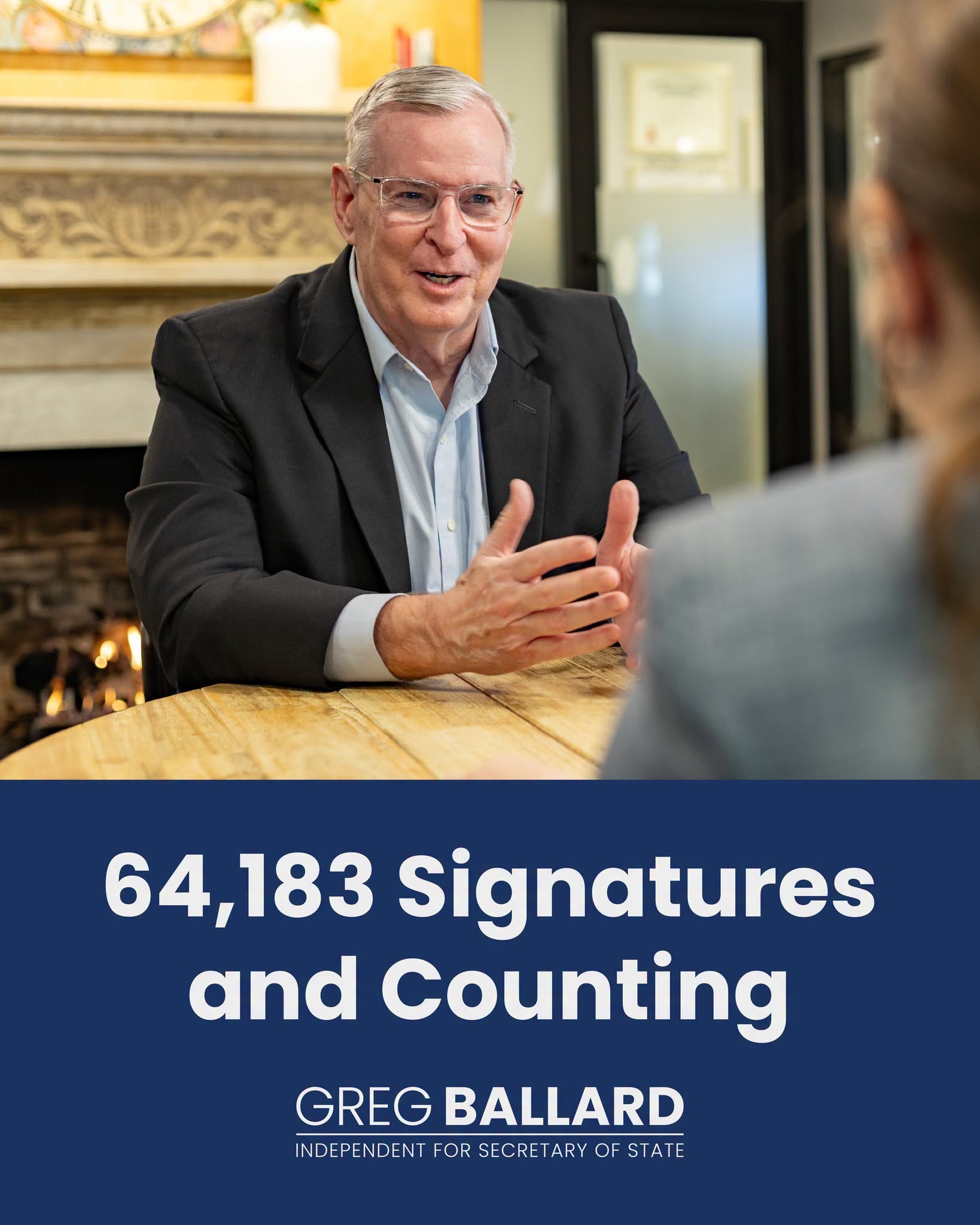
Greg Ballard, an independent candidate for Indiana Secretary of State, is petitioning to gain ballot access for the November race. Today, he announced he has hit 65,000 signatures when he only needs 36,943. This is the Republican mayor who stunned the country in 2007 by beating a popular Democratic incumbent. He recently wrote a book on the experience and is setting the stage to once again disrupt Indiana politics.
I was the last full-time, paid employee of a third party in Indiana, working for the Libertarian Party from 2008 to 2012. So let me explain why this matters.
At 2 percent in the secretary of state race, a third party gets automatic ballot access for its candidates across Indiana. Statewide. Legislative. County. Local.
It also becomes an option for appointments to many boards and commissions. Republicans act like the only alternative is appointing Democrats. It isn’t. They could appoint Libertarians now.
At 10 percent, the Libertarian or Lincoln Party would have to hold a primary.
The benefit? Data.
More than 100,000 Hoosiers consistently vote for Libertarian statewide candidates, and the party has no idea who most of them are. A primary would identify that voter universe and open a direct line to potential donors, candidates, volunteers, and county organizations.
Jeff Maurer received 104,519 votes in 2022, or 5.7 percent. That is why I think Lauri Shillings will clear 2 percent. Indiana has a built-in Libertarian vote, and it is larger than most political professionals want to admit.
Greg Ballard can clear 10 percent, too. He is at roughly 65,000 petition signatures now and could finish near 80,000. He needs about 37,000 valid signatures to make the ballot.
Republicans will challenge him because he is not a curiosity. He is a direct threat to their supermajorities. If the Lincoln Party earns automatic ballot access, it can begin fielding candidates in legislative and local races where Republicans currently face little or no competition. It would run candidates that appeal to purple suburbs. Republicans and Democrats know where their voters are, and they don’t want an influx of new voters (or parties) to disrupt the predictable nature of their business.
That is why party loyalists are suddenly pretending that Greg Ballard is some shady, nefarious figure. Hamilton County Republicans are trying to posit some stolen election theory because it is all they have left. Ballard is a career Marine, a two-term Republican mayor of Indianapolis, and the last Republican to govern Indiana’s capital city. He left office without an ethical cloud hanging over him. Ballard did not change. His usefulness to the Republican Party did.
All of a sudden, local party officials expect us to believe their guy was a bad guy, but the actual bad guys in their party aren’t? Disgust towards that tribal mentality towards politics is exactly why Ballard’s campaign will thrive. When they throw mud, it just promotes his campaign to disaffected voters looking for a new option.
A petition signature is not a vote. But collecting 65,000 to 80,000 signatures proves that the campaign has money, volunteers, organization, and voter contact. That number alone represents 60 to 80 percent of Maurer’s entire 2022 vote total before Ballard has even appeared on the ballot.
The lazy myth is that Libertarians simply take votes from Republicans. The evidence has never consistently supported that. Libertarian candidates pull some voters from both major parties, while much of their support comes from people who finally see their ideas represented or who otherwise would not vote.
Ballard is different from a traditional Libertarian candidate. He is a known, moderate Republican with deep roots in Central Indiana. He appeals directly to the kind of voter who liked and voted for both Barack Obama and Mitch Daniels 20 years ago but no longer recognizes the Republican Party.
That voting bloc has grown dramatically in places like Hamilton County and the Indianapolis suburbs.
So what happens in a four-way race?
Start with the 2022 Secretary of State results. Let Ballard take a little from the Libertarian, a little from the Democrat, and more from the Republican. Then add disaffected suburban voters who return to the polls because Ballard gives them someone to vote for.
I think a conservative model looks like this:
Max Engling , Republican - 774,000 (43.0%)
Beau Bayh, Democrat - 639,000 (35.5%)
Greg Ballard, Lincoln Party - 306,000 (17.0%)
Lauri Shillings, Libertarian - 81,000 (4.5%)
Total 1,800,000 votes
That assumes roughly 60 percent of Ballard’s support comes from Republican-leaning voters, especially in Hamilton, Boone, Hendricks, Johnson, Hancock, and Marion counties. The rest comes from independents, moderate Democrats, Libertarians, and people returning to the polls.
While not a Ballard victory, it is something more dangerous to Republicans: proof that a durable center-right voting bloc exists outside their party in a state that has a lot of Mitch Daniels Republicans on the outs with their party. The Daniels/Holcomb folks are different than the Pence/Braun wing of the party (let alone the MAGA voter), but they still have a lot of connections and capital to throw at targeted races. Those candidates would have a strong appeal to suburban Democratic voters. Think candidates that appeal to voters in the vein of John Gregg, Todd Young, and libertarians like me all at once, and the Senate candidates that just won with Trump’s support are in danger in the general election.
Both Shillings and Ballard are wonderful human beings who would be excellent at the job. Engling and Bayh seem that way as well, but they’re a perpetuation of a system not working for anyone.
Out of 4.9 million Hoosiers eligible to vote in 2024:
• 1.7 million voted Republican (35%)
• 1.16 million voted Democrat (24%)
• 90,000 voted for others (2%)
• 1.9 million didn’t vote (39%)
Shillings and Ballard are the only options for that 39%.
Of the four, Ballard is the only person with real experience for the SOS job, and that will be a huge factor in decision-making. Name ID is also a major strength for Ballard and Bayh, a key component of campaigning. If more people have already heard of you, then you don’t need to spend as much on ads. That will be Beau Bayh’s strategy. The son of former Senator and Governor Evan Bayh and the grandson of Senator Birch Bayh has already raised $2.5 million. That said, straight-ticket voting will be the main bulwark for Republicans. It is how they keep winning.
I think it is a safe bet that Ballard will put the Lincoln Party into the primary system, cut the Republican nominee to the low 40s, and give Bayh a legitimate path to victory. If Ballard reaches the low 20s, the race becomes a toss-up between Engling and Bayh. If he reaches the high 20s, he is no longer a spoiler. He is a contender.
This is the kind of unpredictability that the two-party system hates. Why? It will produce a more moderate politics. A Republican supermajority in Indiana will eventually come to an end, and one of their former champions may be the guy to nudge the boulder downhill.
Watch my recent interview with Ballard here:
What’s the difference between the Lincoln Party and the Libertarian party?
What a lot of voting blablabla….you better explain that voting is or is to be rigged to facilitate the polarisation and keep the real power in power