


“Measures are too often decided, not according to the rules of justice and the rights of the minor party, but by the superior force of an interested and overbearing majority.”
James Madison, Federalist No. 10
Thanks to Rob Kendall (and Casey) of WIBC for having me on this morning to talk about redistricting.
In August, Texas redrew its congressional maps to maximize the number of Republican House seats at the behest of President Trump. This set off a chain of events that led to California, North Carolina, and four other states to redraw maps in the middle of the decade instead of the traditional decennial redistricting, thanks to reapportionment.
Now Indiana has had an intense debate over new maps. The new maps have been released, and they make Indiana look like Illinois. I have a keen interest in this due to my background as Executive Director of the Libertarian Party of Indiana from 2008-2012. Much of my job was helping candidates and county parties deal with election law. Indiana is one of the rare states that is favorable to third-party candidates, for which I am grateful. There’s no greater expression of free speech than running for office, forming a party, or voting. Any attempt to limit ballot choices is an attack on the First Amendment.
“When elections are rare or their results foreknown, the electors grow accustomed to inaction.”
Alexis de Tocqueville, Democracy in America, Vol. 2, Part 2, Ch. 2
Indiana cares about free speech, but that doesn’t mean it isn’t without problems. Straight ticket voting and maps drawn by politicians to maintain their power is the fruit of the poisonous tree when it comes to elections. Limited choices mean more people stay home because they don’t see their views represented on the ballot. The LPIN has consistently shown this in exit polling over the years. For instance, when Lucy Brenton ran for Senate in 2018, she split evenly between Democrats and Republicans at 2% each, but still won 9% of the vote. The idea of a Libertarian stealing votes has never held up under research.
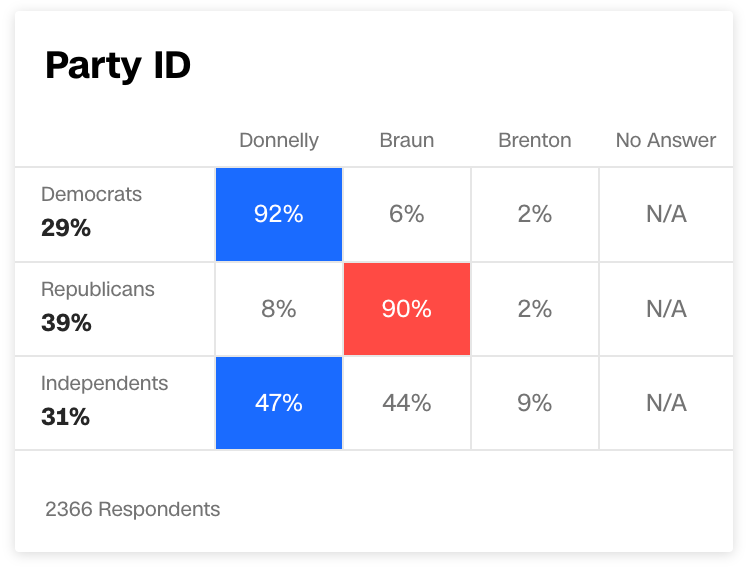
That’s why voter participation is so low in Indiana. Voters don’t see their ideas on the ballot. Look at involvement in 2024.
Out of 4.9 million Hoosiers eligible to vote in 2024:
• 1.7 million voted Republican (35%)
• 1.16 million voted Democrat (24%)
• 90,000 voted for others (2%)
• 1.9 million didn’t vote (39%)
That means about one-third of the state now controls nearly all congressional power. Republicans hold seven of Indiana’s nine U.S. House seats and are considering new maps that could erase the last two Democratic districts.
“The fundamental article of my political creed is that the people must be governed by their representatives, freely, and equally chosen.”
John Adams, Letter to John Taylor, 1814
Take a look at this chart from Planscore.
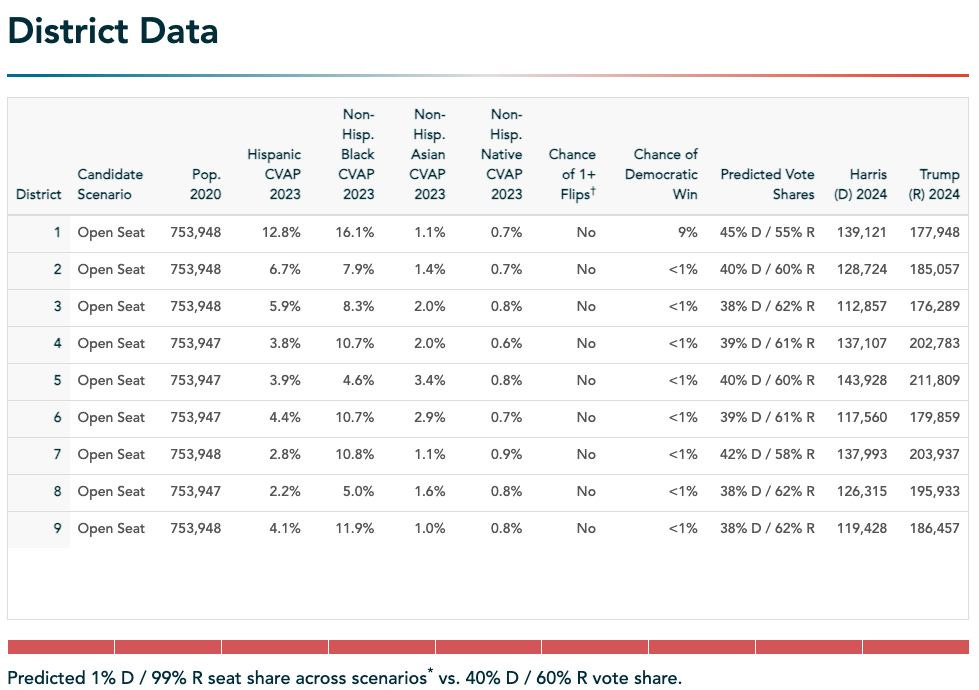
It shows the current maps are set for Republicans to win 60% of the vote share in the Congressional delegation and Democrats take 40%. That makes sense. Trump won 58% of the vote and Harris won 39% of the vote.
But the new plan shifts it from reasonable representation to 99% to 1%, giving them all nine seats because they’re rigging the vote. This is what the founders of the country worried about.
“An elective despotism was not the government we fought for.”
Thomas Jefferson, Notes on the State of Virginia, 1785
The whole American experiment rests on the idea that the people are the ones with the divine right now, not a king, not a party, not a handful of consultants in a room with a map. When a small group uses its temporary majority to cement permanent control, they are not acting like citizen servants, they are acting like the very monarchs we supposedly left behind.
It seems to me that the current plan for some in the GOP is to cheat instead of serve, as the Founders feared. So what is the alternative?
Todd Rokita showed it to us in 2009 with Rethinking Redistricting. He partnered with Common Cause to build this plan (I recall the Brennan Center was also involved). He took a big risk politically and drew maps in the style of an independent commission, and it made a lot of legislators mad.
This is a comparison of his maps with those recently released by the Republicans.
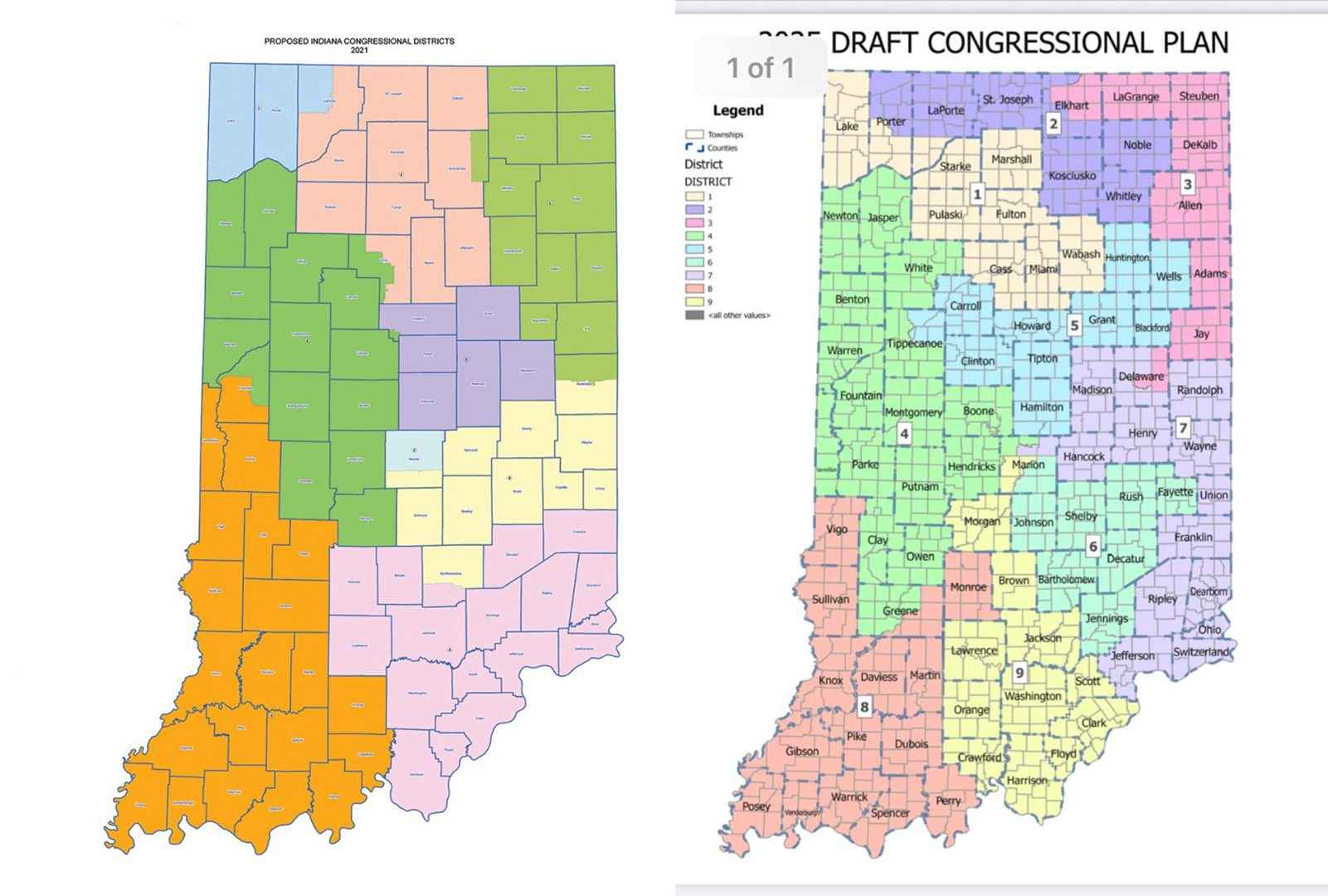
I was a vocal advocate for it. It would mean a fuller expression of free speech and representation, and more people would participate in the vote, which is not something the two parties actually want. They’ve spent a lot of money narrowing the information down to knowing exactly who votes, how, and how they can drive out their voters. If 39% of eligible voters show up, parties would not have had predictable results. The open secret is that maps are redrawn every decade in Indiana to limit competitiveness in the statehouse and Congressional districts, preserving resources. So only 2-5 districts across the House, Senate, and Congress are actually competitive, despite a total of 159 districts. God forbid they have to interview for their jobs! (Citizens United and the changing of politics from precinct-based to fundraising-based also plays a role here, but that’s a different topic for a different time.)
“The true principle of a republic is, that the people should choose whom they please to govern them.”
Alexander Hamilton, Speech in New York Ratifying Convention, 1788
As I said on Election Eve in 2024, the choice for voters was for more of the same with Kamala Harris or something fundamentally new with Donald Trump. Still, neither represents the liberal, democratic, capitalistic vision of America that made our country so prosperous. The choice before Indiana Senators is between embracing the consent of the governed, the Declaration, and the Constitution, or something fundamentally un-American.
“The majority in the United States possesses an authority that is physical and moral at the same time… and there is no power that can resist it.”
Alexis de Tocqueville, Democracy in America, Vol. 1, Part 2, Ch. 7
In summation, Todd Rokita was right in 2009, even if he disagrees with himself now.
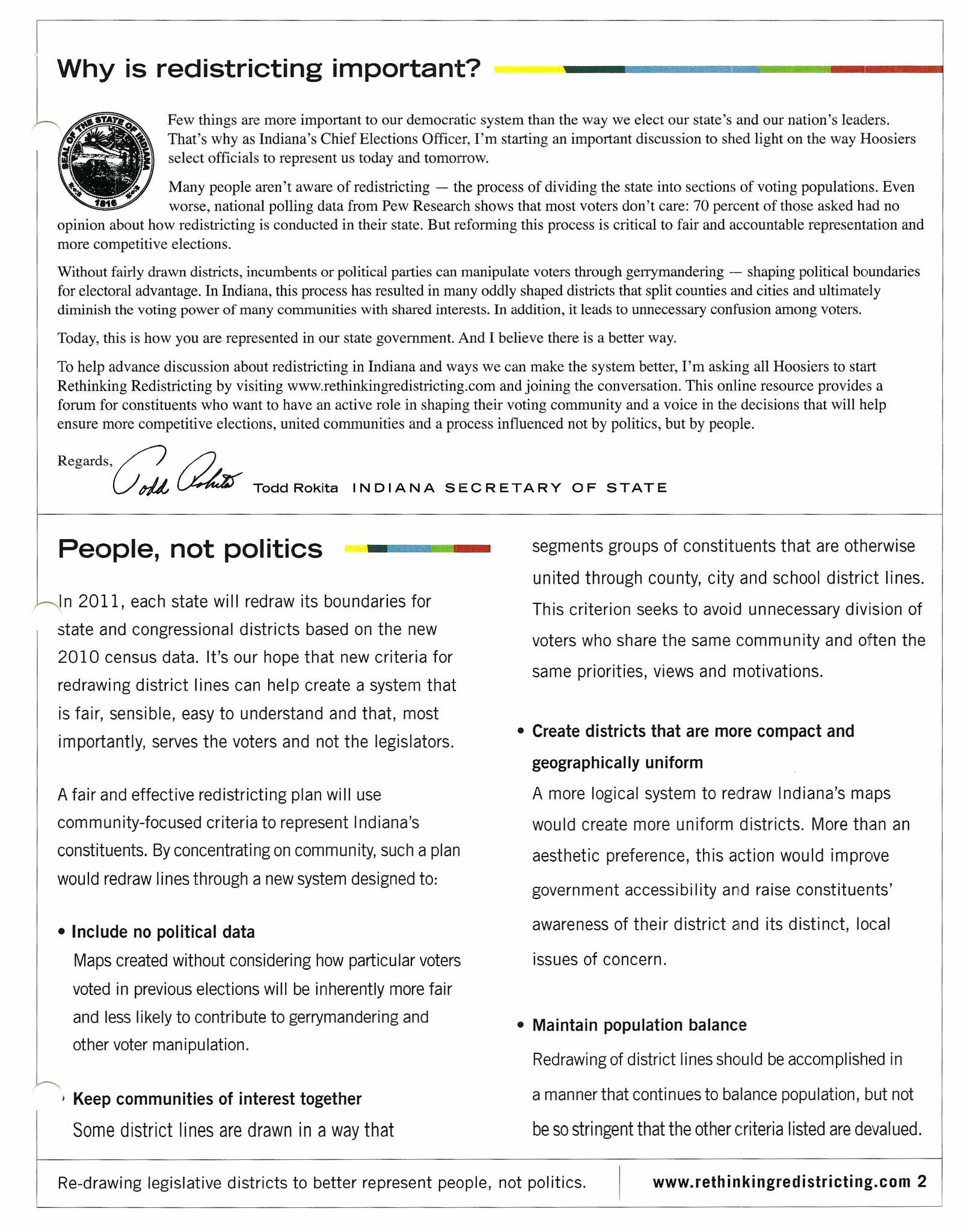
Full PDF is here. This plan disappeared from the SOS website shortly after Rokita left and Charlie White took over. I saved it. White would eventually be charged and convicted of six felonies for voting in an incorrect district and had to resign, something the current SOS, Diego Morales, has been accused of. As of now, he’s faced no consequences for it.
So how do we solve this? What should people who care about the consent of the governed and freedom of speech advocate for?
The Problem:
1. The Current System Lets Politicians Pick Their Voters
Indiana legislators draw their own districts. This creates an obvious conflict of interest and allows districts to be engineered for political protection rather than public accountability.
2. Gerrymandering Splits Communities and Weakens Representation
Indiana maps routinely divide counties, cities, and neighborhoods, scattering people who share common interests.
3. Indiana Suffers From Low Competition and Uncontested Elections
Gerrymandering leads to safe seats and uncompetitive races. The original presentation noted that “40 percent of all legislative races lack major party opposition” and that half of Indiana House districts favor one party by more than 30 percent . When outcomes are predetermined, lawmakers have little incentive to listen to their constituents.
4. Oddly Shaped Districts Cause Confusion and Reduce Voter Trust
The current maps are so contorted that even state materials mock them as resembling objects rather than communities. This confusion undermines voter confidence and makes it harder for people to know who represents them. His document highlights this problem visually with districts described as “a spaceship” and “a staircase” .
The Solutions From Rethinking Redistricting:
The Rethinking Redistricting proposal emphasized four core principles:
• Do not use political data in drawing maps
• Keep communities of interest together
• Prioritize compact and uniform districts
• Respect county, city, and township boundaries whenever possible
These principles come directly from then Secretary of State Todd Rokitas’s criteria list, which states that “maps created without considering how particular voters voted… will be inherently more fair” and should follow organic community boundaries.
1. Nesting Simplifies Government and Reduces Costs
Nesting means pairing two House districts inside every Senate district. This change would reduce voter confusion, streamline ballot design, and make representation more straightforward to understand. The document showed that counties like Hamilton contained nine House districts and five Senate districts, a model that creates administrative chaos. The proposal cuts ballot styles in counties like Johnson by one third and in Elkhart by half .
2. Independent, Community-Driven Redistricting Is Possible
Other states already use criteria such as compactness, community boundaries, and nonpartisanship. The Indiana proposal relied on similar standards. The “What Could Have Been” maps demonstrate that fair districts are entirely legal and comply with the Voting Rights Act while keeping far fewer counties split apart. For example, the prototype reduces county splits in Indiana Senate districts from forty-eight to only twenty-one. Sadly, California is trying to kill its commission due to Trump and Texas’s attempt at mid-cycle redistricting.
3. Fair Maps Improve Accountability and Access
The presentation showed that redistricting reform would:
• Increase competition
• Improve accountability
• Make it easier for citizens to reach their lawmakers
• Reduce election costs and administrative burdens
4. Demographic Change Requires Better Tools
The Rethinking the Redistricting Toolbox article adds a national legal perspective. The authors note the growing complexity of multiracial communities and the decline of old racial voting patterns, which makes traditional tools harder to apply. Demographic diversity is increasing and requires new approaches to ensure fair representation for all racial and language groups .
5. Communities of Interest Are a Valid and Powerful Standard
Coalition districts and community-of-interest protections are increasingly used nationwide. There is a need to give communities of interest real definitional strength so they can be applied consistently in states like Indiana. As the plan says, “consideration of communities of interest is essential” and should be second only to constitutional requirements.
6. Without Reform, Race and Partisan Manipulation Will Get Worse
The overlap between race and party incentives means that both major parties can weaponize districts.
7. Fair Maps Protect Civil Liberties and Limit Government Abuse
For libertarians, redistricting reform is a structural check on government power. Fair maps reduce political entrenchment, protect minority viewpoints, and allow voters to influence their representation without state-engineered outcomes meaningfully.
Quite simply, we have to stop letting politicians cheat. Hoosier legislators are more afraid of Donald Trump than they are their own constituents. Why? Generations of politicians picking their voters instead of letting voters decide.